
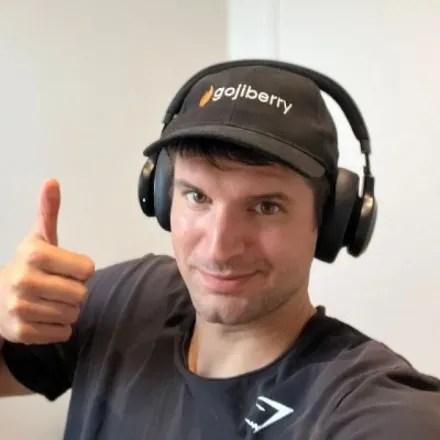

Roman Czerny
Co-founder & CMO at Goji Berry AI
Roman Czerny is the co-founder and CMO of Goji Berry AI. Before Goji Berry, he and co-founder Pierre built and sold a Shopify app together. The playbook they ran at that company is what became Goji Berry: manually searching LinkedIn for people engaging with topics relevant to their product, finding signals, then reaching out cold. It worked well enough that they decided to build software around it.
Goji Berry AI: $1.4M in 9 months, team of 3, now YC
Roman Czerny is the co-founder and CMO of Goji Berry AI. Before Goji Berry, he and co-founder Pierre built and sold a Shopify app together. The playbook they ran at that company is what became Goji Berry: manually searching LinkedIn for people engaging with topics relevant to their product, finding signals, then reaching out cold. It worked well enough that they decided to build software around it.
Goji Berry is a GTM tool that combines intent signals and outreach in one platform. Before it existed, you needed two products: one to find who was showing buying signals, another to reach out. Most people were stitching together Trigify and HeyReach, or some version of that. Goji Berry does both.
In 9 months, Goji Berry hit $1.4M in revenue with over 1,000 customers and a team of 3. Roman just got accepted to Y Combinator and is moving to San Francisco. This is part of our Inside the Stack series.
Quick takeaways from the conversation
- Competitive markets are an advantage. Customers are already trained to pay. The work is standing out, not explaining the category.
- Lead magnets posted weekly on new AI tools (Manus, Claude, Gemini) are the highest-ROI LinkedIn play right now. People comment to get the resource, visit the site, and self-onboard. Some download 7 lead magnets before buying.
- The hardest part of growing on X or LinkedIn is the 0 to 500 follower range. Roman's solution: tag the founders of tools you use with your results. Get reposted by bigger accounts. That builds the first 100-200.
- One excellent post per day, written by hand. Never batch. "If you try to do three or four in the same day, it's not going to work."
- On outbound: reference the subject, not the action. "Cold mailing might be useful to you" beats "I saw you liked this post." Reply rates on the non-AI lead magnet sequence hit 60-70%.
- Split the day. 8am to 2pm is content: post everywhere, reply to everyone. 2pm to 8pm is sales calls. That's the full schedule.
The Goji Berry playbook
1/ Crowded markets are good to compete in
The GTM space has dozens of tools. Roman's take is that competitive markets mean customers already understand the problem and are already paying for solutions. You don't spend the first year educating anyone.
In a non-competitive space, you're convincing people the problem exists before you can sell the solution. In a crowded space, you just need to get attention. The product insight is: how can you combine intent signals and outreach in one tool. People were paying for two products and now it can be done in one.
2/ Go multi-channel from day one
Roman didn't pick one platform and build from there. Goji Berry launched on LinkedIn, X, Reddit, YouTube, and email marketing simultaneously.
95% of Goji Berry's buyers never talk to anyone. They find the content, visit the site, and self-onboard. 5% take a call. That ratio only works if the content is everywhere.
3/ Lead magnets are the number one growth loop
Every week, or close to it, Roman posts a lead magnet on a new AI tool. Manus drops, he builds a resource on how to use it for outbound. Claude ships a new feature, he documents it and posts. People comment to get the resource, they visit the site, they self-onboard.
Some customers downloaded 7 lead magnets before buying. Each one is another touchpoint.
Creating one excellent post is genuinely hard. If you sit down and try to write four great ones in the same session, you won't get four great ones.
Roman writes one post per day by hand. No batching. His daily split: 8am to 2pm is content, posting, and replying to every comment. 2pm to 8pm is sales calls.
4/ Tap and activate the ecosystem
The hardest stretch on any platform is 0 to 500 followers. Roman's approach: tag the founders of tools you're getting results with. If a product is working for you, screenshot the results and tag the founder. They repost it, their audience sees you, and you pick up followers you'd never have reached otherwise.
On outbound, the same principle applies at the message level. Two sequences run simultaneously. The non-AI sequence takes whatever lead magnet is performing best on LinkedIn or X and crafts outreach around it. Reply rates: 60-70%.
The AI-assisted sequence follows one rule: reference the subject, not the action. "Cold mailing seems like something you're working on" rather than "I saw you liked this post." Or if someone is hiring for sales: "looks like your sales team is expanding" rather than "I saw your job posting." People clock action-level personalization immediately.
5/ The Goji Berry tool stack
Three people running a $1.4M business:
- Goji Berry for intent signals and outreach (their own product)
- Claude for the backend: lead qualification and personalized message generation
- ChatGPT + Gemini for Roman's own writing and content
- Claude Code for engineering (CTO maxes out tokens daily)
- Stripe for payments
The full conversation
Why did you build Goji Berry? Why this space?
Cold outreach without context doesn't work. The reply rates are bad and the connection invites are limited. LinkedIn caps how many connection invites you can send each week, so if you're spraying cold messages to people who've shown zero interest, you're burning through those slots on people who'll never respond.
At my last company, Pierre and I would go on LinkedIn, search for keywords related to what we were selling, and find the people actively engaging with those topics. Commenting, posting, asking questions. Then we'd reach out. It sounds manual because it was, but it worked. Higher reply rates. More relevant conversations.
We built Goji Berry to productize that motion. Then we realized something later in the process: no GTM tool was actually doing both sides. You had signal tools and you had outreach tools. Everyone was using two products. We put them in one.
How do you grow in such a competitive market?
Multi-channel from day one. We took every platform we know how to go viral on and made it part of the strategy: LinkedIn, X, Reddit, YouTube, email marketing. The only gap is short-form video and UGC. We haven't figured that out yet and need to hire for it.
Every week, or close to it, we post a lead magnet on new AI tools. Someone drops Manus, we build a resource around how to use it for outbound. Someone uses Claude for a new workflow, we document it and post it. People comment to get the resource, they go to the site, they self-onboard. 95% of buyers never talk to us. They come through the content and onboard without a call.
The bigger players in GTM have been around 5 to 10 years. They're slow to react to new AI releases. We can have something out the week a tool launches. That speed gap is where the growth happens.
How do you engineer virality?
Follower count doesn't matter much on LinkedIn. Going viral there is extremely hard, harder than X. The approach that works is lead magnets: post something where people comment to get a resource. Change the resource every week. Some of our customers downloaded 7 lead magnets before they converted. Each one is a new touchpoint, brings new people in, and gives the algorithm something to run with.
On X it's different. You just tell stories. Share results from outbound experiments, cold email tests, things that worked or didn't. It has a different distribution dynamic and stories travel faster there.
The hardest stretch is 0 to 500 followers on either platform. The way out of it: tag the founders of tools you're getting results with. If you're using a product and it's working, screenshot the results and tag the founder. They repost it, their audience sees you, and you pick up followers you'd never have reached otherwise. That's how you get the first 100 to 200.
My schedule is 8am to 2pm: post everywhere, reply to every comment, stay in every conversation. 2pm to 8pm is sales calls only. That's the split.
How do you use AI tools day to day?
Claude runs the Goji Berry backend. Lead qualification, writing personalized messages. Our developer, who is also the CTO, uses Claude Code every day and maxes out the tokens.
For my own writing I use ChatGPT and Gemini. I don't write posts with Claude.
The content itself is all hand-written and I do one post per day. No batching. Creating one excellent post is genuinely hard. If you sit down and try to write four great ones in the same session, you won't get four great ones. You might get one.
What's working on outbound messaging?
Two sequences running at the same time. The first is non-AI. We take whatever lead magnet is performing best on LinkedIn or X and craft the outreach around it. The message is: here's this resource, it's been useful for people doing X, want me to send it over? That sequence gets 60 to 70% reply rates.
The second is AI-assisted. The rule there is never reference a specific action. Don't say "I saw you liked this post" or "I noticed you commented on this thread." People clock it immediately. Instead, go to the subject level. "Cold mailing seems like something you're working on" rather than "I saw you engage with this cold email post." Or if someone is hiring for a sales role, the message is "looks like your sales team is expanding, might be good timing to talk" rather than "I saw your job posting."
Lemlist still works if you can write. The tool is only as good as the copy.
Goji Berry reached $1.4M in revenue in 9 months with three people. If you're doing outbound and stitching together a signal tool with a separate outreach platform, Goji Berry is worth a look. Free trial at gojiberry.ai.
Roman's Tool Stack


Anthropic's CLI coding agent with custom skills, MCP integrations, and agentic workflows.


About Goji Berry AI
A GTM tool that combines intent signals and outreach in one platform. $1.4M revenue in 9 months with a team of 3. YC-backed.